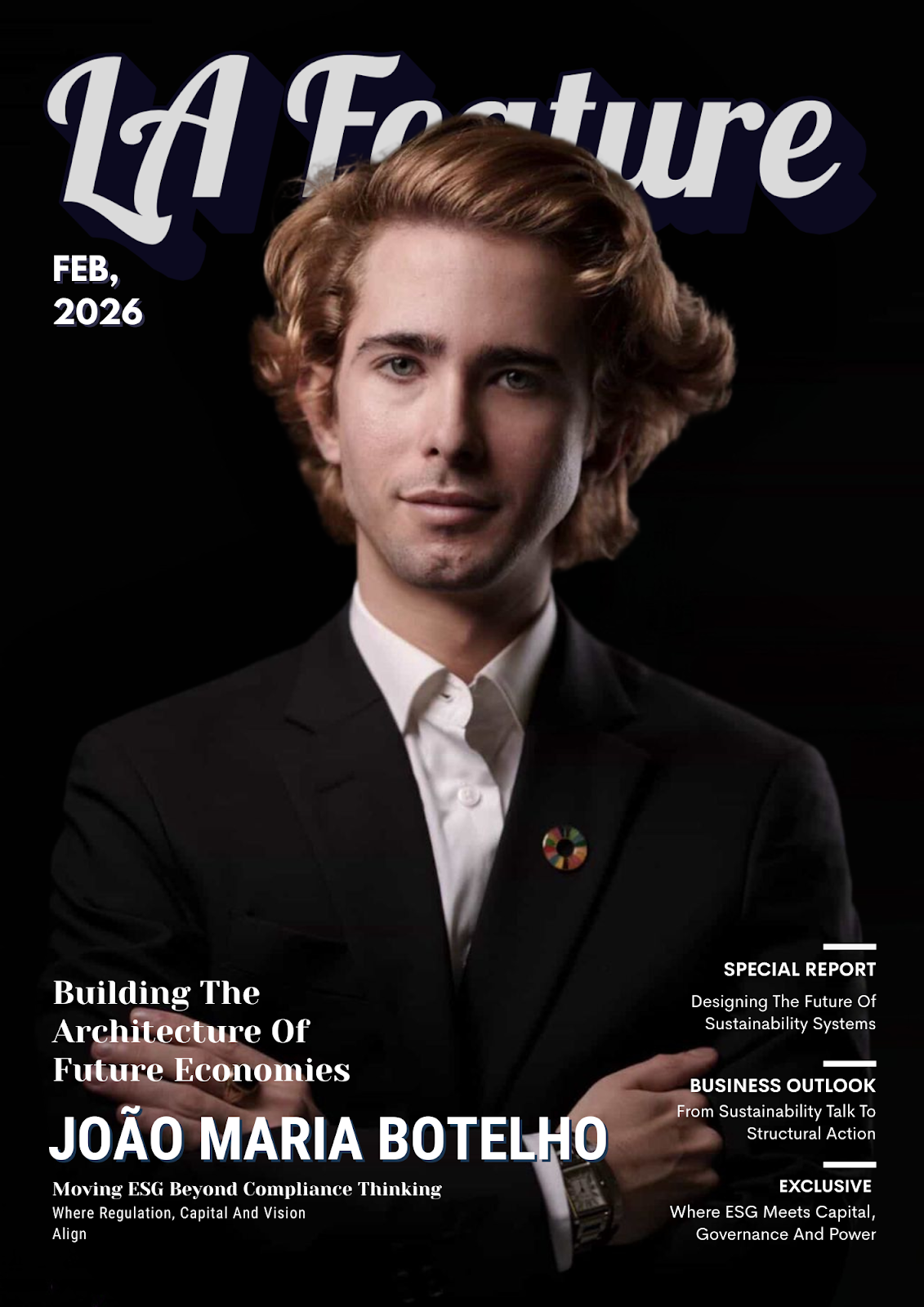


In a world where sustainability is often reduced to buzzwords, João Maria Botelho stands apart—not as a commentator, but as a systems thinker. His work does not orbit around visibility or trends; instead, it is anchored in structure, literacy, and long-term institutional transformation. At a time when ESG dominates headlines yet remains widely misunderstood, Botelho is building something far more enduring: a framework for how the next generation engages with sustainability at its core.
From Awareness to Architecture
João’s journey into sustainability did not begin with a single defining moment. It emerged gradually—through exposure to law, governance, and the intricate systems that shape public and economic life. While studying at NOVA School of Law, he became increasingly aware of a disconnect that few were addressing. Sustainability was everywhere in conversation, yet rarely treated as a matter of legal design or economic structure.
This realization became the intellectual foundation for his work.
By 2023, against the geopolitical backdrop of COP28 in Dubai, João formally launched Generation Resonance—an international platform designed not to amplify voices, but to elevate the quality of engagement between emerging leaders and institutional decision-makers. It was not a campaign. It was a structural response to a systemic problem.
The Turning Point: Where Technology Meets Regulation
A pivotal moment came when João began advising a U.S.-based AI startup focused on ESG applications. For the first time, he witnessed how technology, regulatory frameworks, and capital markets were colliding in real time. Companies were grappling with disclosure requirements. Investors demanded measurable metrics. Founders navigated regulatory landscapes they barely understood.
What he observed was not a lack of ambition—but a lack of literacy.
At the same time, his involvement in EU sustainability regulation and participation in international governance spaces, including UN climate negotiations in Bonn, exposed another reality: decision-making is highly concentrated. The frameworks that shape global capital flows are negotiated in rooms that most young professionals never access—and even fewer truly understand.
For João, this was not just an observation. It was a call to action.
Bridging the Literacy Gap
Before Generation Resonance, there was Decoding Sustainable Finance—a project João co-founded with close collaborators. Its mission was simple but urgent: translate complex ESG and financial concepts into language that people could actually understand.
The initiative gained national recognition in Portugal for its contribution to financial literacy. But for João, the real success lay elsewhere. It revealed a deeper truth: sustainability was being approached superficially across sectors.
Companies wanted to be greener—but lacked regulatory understanding.
Young professionals wanted ESG careers—but did not grasp financial mechanics.
Public discourse focused on environmental narratives—while ignoring governance and capital allocation.
This is the gap João is committed to closing.
To him, sustainability is not a department. It is a structural lens—one that shapes strategy, investment, governance, and technological development. Without systemic understanding, implementation will always remain superficial.
A Unique Intersection of Worlds

What distinguishes João is not a single achievement, but the intersection of domains he operates within. He moves seamlessly between regulatory advisory, international governance, and grassroots educational initiatives.
He has contributed to EU regulatory discussions, participated in UN climate processes, and coordinated Portugal’s first ESG Handbook—an intellectual infrastructure project designed to guide a nation entering a new regulatory era. Simultaneously, he has built independent platforms without institutional funding, proving that influence does not require permission—only clarity and discipline.
This duality defines his approach.
He understands sustainability from inside formal systems, where language shapes policy and capital flows. And he understands it from the outside, where individuals and businesses are still trying to decode its meaning.
Equally important is his ability to communicate. From TEDx stages to podcasts, João has consistently translated complexity into clarity—without diluting substance. He does not simplify to impress; he clarifies to empower.
Choosing Impact Over Visibility
João’s approach to projects reflects a broader philosophy: sustainability must scale across systems, not just ideas. In a globalized economy, where supply chains and capital flows transcend borders, impact cannot remain local.
This is why his focus extends to strategic jurisdictions—regions such as MENA, Monaco, and emerging African markets. These are not peripheral spaces; they are central nodes in global economic design. Embedding sustainability within these ecosystems means influencing decisions where they truly matter.
When evaluating opportunities, João asks critical questions:
- Can this project scale across jurisdictions?
- Can it influence decision-making at multiple levels?
- Can it move beyond compliance into strategic transformation?
For him, sustainability is not about reacting to systems—it is about conditioning them.
Motivation: Leverage and Responsibility
At the core of João’s work lies a powerful motivator: leverage.
He is driven by the idea that well-designed frameworks—whether regulatory clauses, governance models, or financial structures—can influence thousands of downstream decisions. Awareness alone does not create change. Architecture does.
Yet beyond this structural perspective, there is a deeply personal dimension.
João believes in generational responsibility. He does not want the next generation to inherit systems they do not understand. By equipping young leaders with regulatory literacy, financial insight, and geopolitical awareness, he aims to multiply impact far beyond individual careers.
His work is not about creating followers. It is about creating informed participants in systems of power.
Redefining Success
For João, success is not a moment of recognition. It is alignment.
It is the alignment between what we say and what we build. Between values and incentives. Between public narratives and institutional frameworks.
Recognition—from awards to international platforms—is meaningful, but secondary. What matters is durability. Does the work create something that remains useful beyond the cycle of attention?
Projects like the ESG Handbook and Decoding Sustainable Finance represent this philosophy. They are not campaigns; they are infrastructure.
Success, in his terms, is influence that compounds over time.
Milestones That Matter
Among João’s many achievements, coordinating Portugal’s first ESG Handbook stands as a defining milestone. It was not just a publication—it was a national framework, bringing together experts to structure ESG understanding during a critical regulatory transition.
Its international presentation, including in Monaco, reinforced a key principle: depth travels.
Another pivotal experience was participating in UN climate negotiations in Bonn. Witnessing how diplomatic language translates into capital flows and national commitments transformed his perspective. Sustainability, in that moment, became visibly geopolitical.
Yet, perhaps most meaningful to João is the Decoding Sustainable Finance project—a smaller initiative with a profound mission. Its national recognition validated something he believes deeply: clarity is power.
The Road Ahead: From Compliance to Redesign
Looking forward, João’s vision is clear—move sustainability beyond disclosure into structural economic redesign.
His future work will focus on the intersection of EU regulation, capital markets, and strategic global jurisdictions. As Europe continues to set regulatory standards, the challenge will shift from framework creation to implementation and enforcement.
Through Generation Resonance, he aims to expand strategically—not for visibility, but for influence. The goal is to embed sustainability into financial hubs, supply chains, and investment ecosystems across regions.
At the same time, he remains committed to advancing literacy. As ESG evolves, the conversation must shift toward incentive alignment and governance reform. This requires engaging not only with individuals, but with institutions.
Long-term, João aspires to help shape a regenerative economic model—one that is not only sustainable, but structurally aligned with long-term value creation.
A Builder of Systems, Not Narratives
In an era saturated with sustainability rhetoric, João Maria Botelho represents something rare: coherence.
He does not chase trends. He builds frameworks.
He does not amplify noise. He creates clarity.
He does not operate at the surface. He works at the level of systems.
And perhaps that is his greatest strength.
Because in the end, real change does not come from what we say—it comes from what we design.